
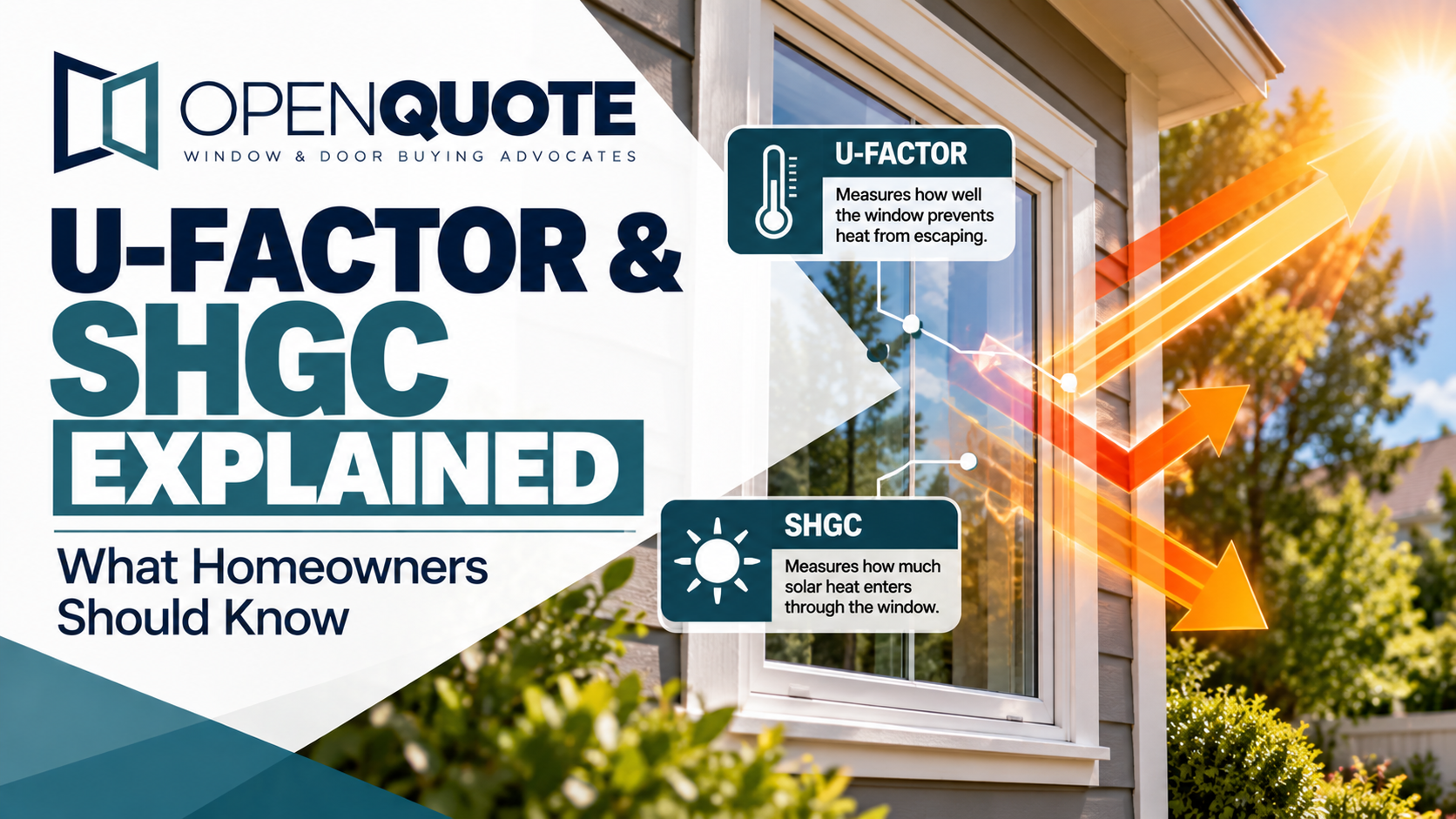
U-Factor and SHGC Explained: What Homeowners Should Know Before Buying Windows
U-Factor and SHGC:
When shopping for replacement windows, you'll probably hear terms like U-Factor, SHGC, Low-E, ENERGY STAR, and energy efficiency.
But what do those numbers actually mean?
Window performance ratings can look complicated, especially when you're trying to compare multiple products or contractor quotes.
Two windows may both be advertised as “energy efficient” while having different performance ratings.
Understanding two of the most common ratings—U-Factor and Solar Heat Gain Coefficient (SHGC)—can help you better understand what you're actually buying.
Already Have a Window Quote?
If your quote includes terms like U-Factor, SHGC, Low-E, or ENERGY STAR and you're not sure what they mean, OpenQuote can help you understand the details.
OpenQuote provides independent window and door quote reviews for homeowners. We help you evaluate the products, glass packages, performance information, installation details, warranties, options, and pricing included in your proposal.
We don't sell or install windows and doors. We help you buy them.
Window and door quote reviews start at $149.
What Is U-Factor?
U-Factor measures how well a window helps prevent heat from passing through the entire window assembly.
In simple terms:
The lower the U-Factor, the better the window is at resisting heat transfer.
For example, if you're comparing two windows and one has a U-Factor of 0.25 while another has a U-Factor of 0.30, the window rated 0.25 provides greater resistance to heat transfer.
However, U-Factor shouldn't be the only number you consider when choosing a window.
Your climate, home, window orientation, glass package, and other factors can also matter.
What Is SHGC?
SHGC stands for Solar Heat Gain Coefficient.
It measures how much solar heat passes through a window and enters your home.
SHGC is expressed as a number between 0 and 1.
Generally:
Lower SHGC = less solar heat enters the home.
Higher SHGC = more solar heat enters the home.
For example, a window with an SHGC of 0.20 allows less solar heat through than a window with an SHGC of 0.35.
That doesn't automatically mean the lower number is always better.
The appropriate SHGC can depend on your climate, the direction your windows face, shading, and other characteristics of your home.
U-Factor vs. SHGC: What's the Difference?
These two ratings measure different things.
U-Factor measures heat transfer through the window.
SHGC measures heat from the sun entering through the window.
Think of it this way:
U-Factor helps tell you how well the window insulates.
SHGC helps tell you how much solar heat the window allows into your home.
Both can be useful when comparing replacement windows.
What Does Low-E Glass Have to Do With It?
Low-E stands for low-emissivity.
Low-E glass uses a thin coating designed to influence how heat moves through the glass.
Different Low-E coatings and glass packages can produce different U-Factor and SHGC ratings.
This is one reason simply asking whether a window has “Low-E glass” doesn't tell you everything you need to know.
Two windows may both have Low-E glass but still have different performance ratings.
When comparing quotes, ask which specific glass package is included.
What About Double-Pane and Triple-Pane Windows?
The number of panes can also affect window performance.
A double-pane window typically contains two panes of glass separated by an insulated space.
A triple-pane window uses three panes and additional insulated spaces.
Triple-pane windows can offer different thermal performance than comparable double-pane configurations, but that doesn't automatically mean every homeowner needs triple-pane windows.
The complete window design matters.
Instead of comparing windows based only on the number of panes, compare the actual performance ratings of the specific configurations you're considering.
What Is an NFRC Label?
When comparing replacement windows, you may see performance information associated with the National Fenestration Rating Council (NFRC).
NFRC ratings provide standardized information that can help consumers compare the energy performance of windows, doors, and skylights.
Depending on the product, the label may include ratings such as:
- U-Factor
- Solar Heat Gain Coefficient
- Visible Transmittance
- Air Leakage
- Condensation-related ratings
The important thing for homeowners is that these ratings provide more specific information than general marketing phrases such as “high efficiency” or “energy saving.”
What Does ENERGY STAR Mean?
ENERGY STAR certification is another term you'll commonly encounter while shopping for windows.
Qualifying products must meet applicable energy-performance requirements.
However, don't assume that every ENERGY STAR window has identical performance.
Different products and configurations can have different ratings.
Your location can also affect which performance characteristics are appropriate.
Don't Compare Windows Based on Marketing Claims Alone
Consider two window companies.
Company A says:
“Our windows are extremely energy efficient.”
Company B says:
“Our windows use advanced energy-saving glass.”
Those statements sound impressive, but they don't give you much information for an actual comparison.
Instead, ask both companies for the specific performance ratings of the windows included in your quotes.
Now you have something measurable to compare.
Make Sure You're Comparing the Correct Window Configuration
This is particularly important.
A manufacturer may offer multiple glass packages, frame options, and window styles.
Performance ratings can differ depending on the exact configuration.
If your salesperson shows you performance numbers, ask whether those numbers apply to the specific window and glass package included in your quote.
Don't assume that one rating represents every window made by that manufacturer.
Questions to Ask Your Window Company
Before choosing your replacement windows, consider asking:
- What is the U-Factor of the window I'm purchasing?
- What is the SHGC?
- Which glass package is included?
- Does the window use Low-E glass?
- Is it double-pane or triple-pane?
- Are these ratings for the exact configuration in my quote?
- Is there an NFRC rating available?
- Does the product meet applicable ENERGY STAR requirements?
- Are upgraded glass packages available?
- Why are you recommending this glass package for my home?
A knowledgeable salesperson should be able to explain what they're recommending and why.
Don't Let One Number Make the Decision
Energy-performance ratings are useful, but they're only part of the window-buying decision.
You should also consider:
- Window construction
- Installation method
- Warranty
- Glass package
- Features and options
- Contractor
- Installation quality
- Price
- Your home's specific needs
A window with impressive performance numbers isn't automatically the best overall choice for every homeowner.
The goal is to understand what you're buying and why it makes sense for your home.