
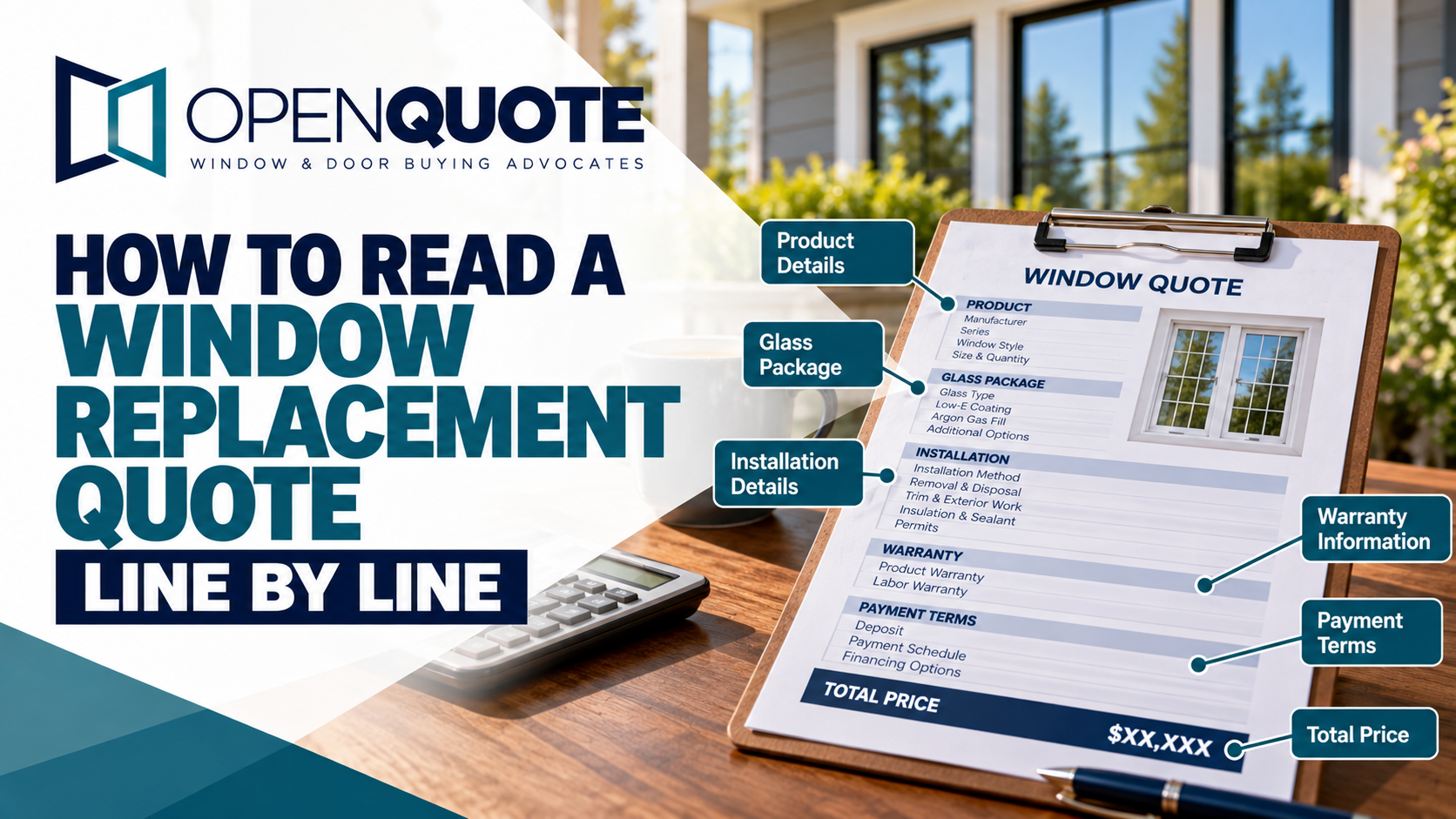
How to Read a Window Replacement Quote Line by Line
A replacement window quote can look pretty simple at first.
You see the number of windows, maybe a few product details, and then the total price at the bottom.
But when you're spending thousands of dollars on a project, the total price shouldn't be the only part of the quote you understand.
I've seen plenty of window quotes where important details were either buried in the fine print or weren't listed at all.
Here's how I would go through a window quote before signing anything.
Have a Window Quote You Don't Fully Understand?
That's exactly what OpenQuote is designed to help with.
We independently review window and door quotes and help homeowners understand the products, pricing, installation, warranties, options, and other details before they sign.
We don't sell windows or doors. We help you understand what you're buying.
Independent quote reviews start at $149.
1. Start With the Exact Window You're Buying
The first thing I want to know is exactly what product is being quoted.
Your proposal should ideally identify the manufacturer and window series, not simply say something like:
“10 vinyl replacement windows.”
That's not enough information to know what you're actually buying.
Many manufacturers offer several different window lines at different price and performance levels.
If the exact series isn't listed, ask for it.
2. Check the Window Styles and Sizes
Next, make sure the quote accurately reflects what's actually going into your home.
Look at the quantity and styles being quoted.
Are they double-hung, single-hung, casement, slider, picture windows, or something else?
Also look for specialty shapes, oversized windows, tempered glass, or other items that could affect the price.
It sounds simple, but you want to catch mistakes before the contract is signed and the windows are ordered.
3. Look at the Glass Package
This is one area I think homeowners often overlook.
Don't assume every replacement window comes with the same glass.
Look for details such as:
- Double-pane or triple-pane
- Low-E glass
- Argon or another gas fill
- Tempered glass where required
- Obscure or privacy glass
- Grids or decorative options
If you're paying extra for an upgraded glass package, make sure you know exactly what the upgrade is.
4. Understand the Installation
This is a big one.
A quote can tell you everything about the window and almost nothing about how it's actually going to be installed.
Find out whether you're receiving an insert replacement or a full-frame replacement.
Ask what happens to the existing frame, trim, insulation, sealant, and exterior materials.
If there is damaged or rotted wood discovered during installation, find out how that's handled too.
A good window installed poorly can still give you problems.
5. Find Out What's Included in the Price
Don't assume something is included just because you think it should be.
Look for things like removal of the existing windows, disposal, interior trim, exterior trim or capping, insulation, caulking, cleanup, permits if required, and any other project-specific work.
If something isn't listed, ask.
It's much easier to clarify the scope before the project starts than argue about it afterward.
6. Read the Warranty Section
When someone tells you a window has a “lifetime warranty,” that doesn't tell you very much by itself.
Whose lifetime?
What parts are covered?
Is labor included?
Is glass breakage covered?
Is the warranty transferable if you sell your home?
Does the installation company provide a separate workmanship warranty?
You don't need to memorize every line of the warranty, but you should understand the major limitations before making your decision.
7. Look Closely at the Payment Terms
Your quote should explain how and when you're expected to pay.
You might see a deposit, progress payment, final payment after installation, financing terms, or another payment structure.
Understand when each payment becomes due.
If you're financing the project, don't focus only on the monthly payment.
Look at the total amount being financed, interest rate, term, and overall cost.
A lower monthly payment doesn't necessarily mean you're getting a better deal.
8. Look for Additional Charges
This is where I would slow down and read the fine print.
Are there charges for things such as rotten wood, permit fees, additional labor, specialty installation conditions, or changes discovered after the project begins?
Not every possible condition can be known before installation.
But you should understand how unexpected costs will be handled if something comes up.
9. Check the Cancellation Terms
Before signing, understand what happens if you change your mind.
Look for the cancellation policy and any applicable cancellation period.
Also find out what happens once your windows have been ordered.
Custom-made products may have different cancellation rules than standard products, so this is something you want to understand beforehand.
10. Finally, Look at the Total Price
Notice that I put the total price last.
That's intentional.
The total matters, but it's much easier to judge whether a quote is expensive or reasonable after you understand what the price actually includes.
Two companies could both quote you 12 windows and be thousands of dollars apart.
That doesn't automatically mean one company is overpriced.
They may be quoting different products, glass packages, installation methods, warranties, or scopes of work.
Or one company really could just be more expensive.
The quote should give you enough information to figure out which one it is.
The Bottom Line
Before signing a window replacement contract, you should be able to answer a few basic questions:
What window am I buying?
What options am I getting?
How is it being installed?
What's included in the price?
What does the warranty cover?
When and how am I paying?
If you can't answer those questions after reading your proposal, don't be afraid to ask the salesperson for clarification.
A replacement window quote shouldn't just tell you what you're paying.
It should help you understand what you're paying for.